

The stock market was born in 1602 on the frigid shores of the Netherlands and has done nothing but heat up for the 422 years since as evidenced by the fact the S&P 500 hit a new all-time high on Jan. 30th.
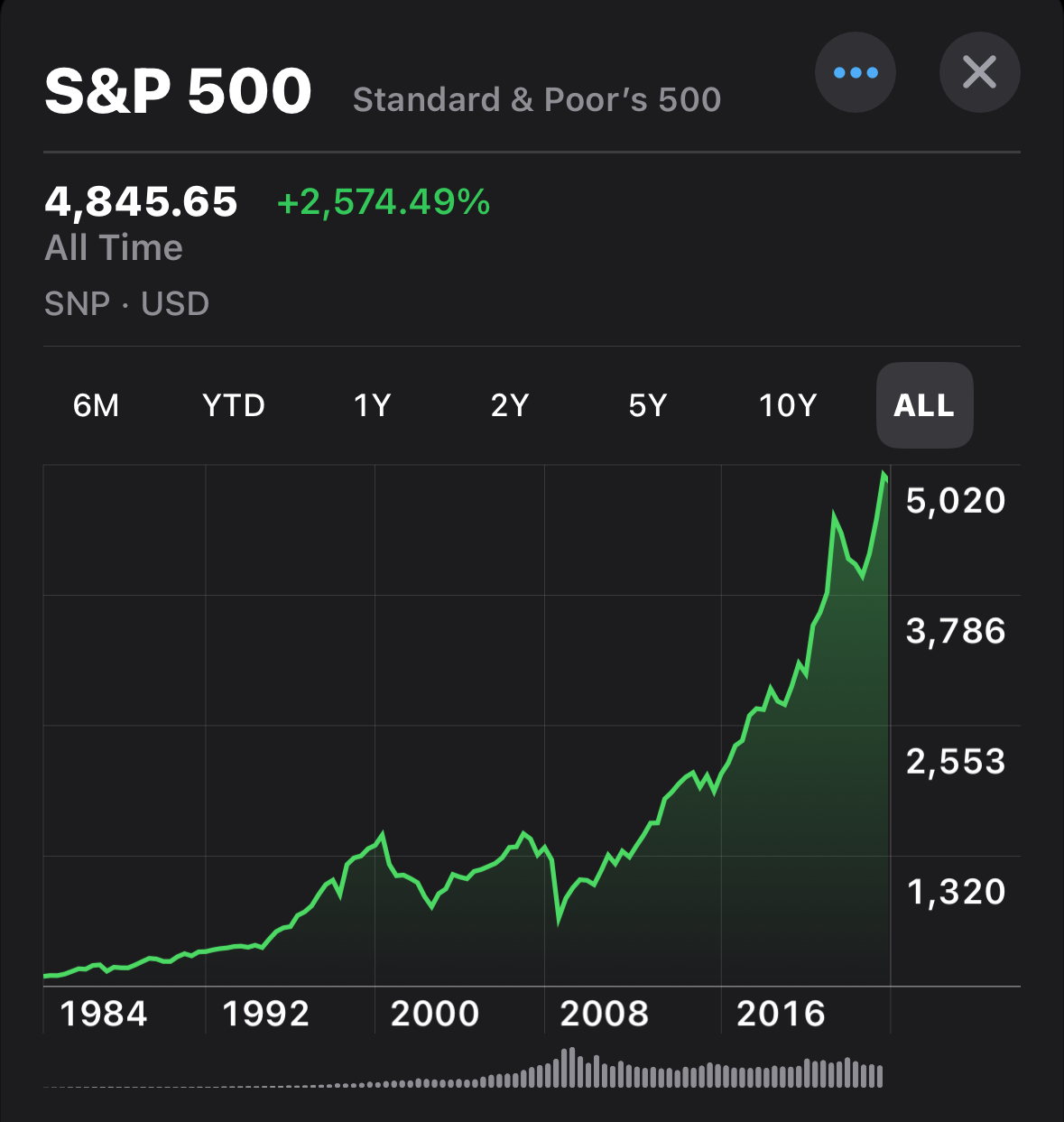
To quote myself, “The stock market allows everyone from a school bus driver, to a corporate lawyer, to me sitting on my couch in sweatpants to buy and sell pieces of the biggest, best companies in the world. Not many people fully grasp the magnitude of that. My resume can (and does) truthfully say that I’m a co-owner of every company in the S&P 500.”
It’s wild.
And as long as the market has been around, people have been trying to figure it out.
I’ve compiled 10 of my favorite sayings which try to boil down the movements of the market into short and actionable insights.
The real truth is nothing works all the time. These quotes are true sometimes, and woefully wrong other times. But they exist for a reason and they’re fun to discuss.
Here’s the Poor Choices Almanac for how to put those time-tested quotes to good use in 2024.
10 Wall Street Sayings for Today’s Market
1. So goes January, so goes the year.
It’s been said January sets the tone for the remainder of the year. If the market does well in January, it will presumably do well for the rest of the year. This is actually backed up by data, too.
The team over at Datatrek Research analyze this type of data often. Here are some recent numbers from them:
In 2022, “the S&P and NASDAQ fell 5.3% and 9.0% in January 2022 – both over one standard deviation to the downside – and ended the year lower by 18.0% and 33.1% respectively.”
Then in 2023, “the S&P and NASDAQ gained 6.2% and 10.7% in January versus the averages of +0.9% and +2.3% for all Januarys since 1980.“
The S&P 500 went on to finish the year up 24% and NASDAQ rose an even more astonishing 43%.
Because we just finished the month of January 2024 with the S&P up about 2% and the NASDAQ up about 3.5%, it stands to reason we could see tepid returns for 2024, but returns nonetheless.
2. Sell in May and go away.
The phrase “Sell in May and go away” is a popular adage in the stock market, suggesting that investors should sell their stocks in May and stay out of the market until the Fall, as historical stock market trends indicate lower returns during the summer months.
The problem is there’s never a “green light” to get back in. The market is not going to text you.
You may very well sell your stocks in May, only to watch the market advance 10 or 20%, leaving you feeling like it’s now too expensive to get back in.
Skip this saying.
3. The market climbs a wall of worry.
Every market decline looks like a great buying opportunity in hindsight. It’s easy to forget how scary big drops can be. Especially when it’s caused by an exogenous shock like a war or a pandemic. The news outlets pick them up and prey upon our fears. It feels like the market is never done crashing.
But sooner or later the market crawls back, inch by inch. With or without you.
There will always be something to worry about. Use this to your advantage. Set a small recurring investment every week or month for the rest of the year and try not to check it. The dust will never settle.
4. The market takes the stairs up and the elevator down.
Related to the previous saying, this metaphor means the market advances slowly, with lots of fits and starts, but often up and to the right. But once in awhile, herd mentality takes over and everyone decides to start selling. Sure enough, years of gains can be erased in a few short weeks or months.
For example, during the 2008 Global Financial Crisis, the market erased all the gains it had made and dropped back to 1996 levels in just a few months.
The nice thing is because declines often happen faster than increases, they are more easily acted upon. The way I like to play this one is to always keep a little extra cash on hand.
The VIX is the Wall Street fear gauge (it’s a ratio of puts to calls). Watch the VIX when the elevator starts dropping.
If the VIX spikes to 28, or 36, or god forbid 60+ like it did in March 2020 as the pandemic unfolded around the world, you know pessimism is high.
5. Don’t try to catch a falling knife.
This one is simple. It relies on price momentum. As in, when the price of a stock is going up, it tends to keep going up. And when the price is going down, it tends to keep going down. This decline is the “falling knife.”
It can be tempting to look at a stock that has been cut in half or worse and think it’s a great time to buy. And maybe it is. Maybe you will catch the “knife” by the handle.
But more often than not you will catch the knife by the blade and it will drop another 50% leaving you in the red.
This is why it’s best to avoid buying individual stocks altogether; companies go out of business all the time. With index funds, you need not worry if the price will ever return to its former highs again. It may take some time, but it’s almost guaranteed.
6. Never short a new high or buy a new low.
This saying builds upon many of the others here. Momentum is a powerful factor. If something is going up, it is likely there are good business and economic conditions as a tailwind and vice versa if it’s trending lower.
In fact, buying at all-time highs often results in better performance than off the highs:
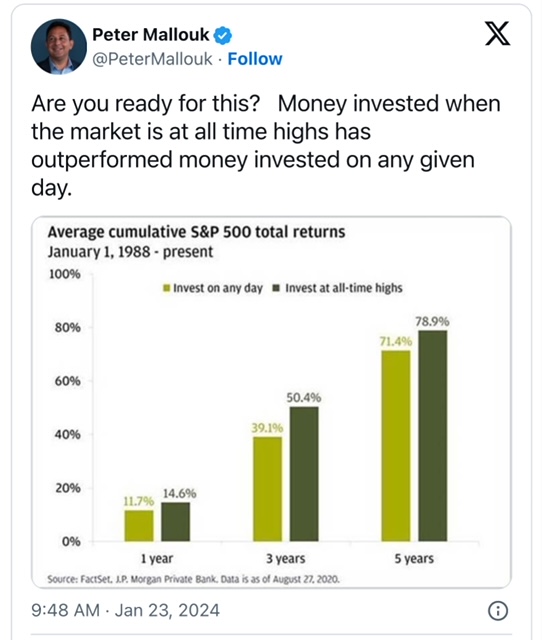
Like an ocean riptide, it’s ill-advised to swim against it. Keep this in mind as the year progresses.
7. Buy low, sell high.
This is much harder than it sounds, yet it is how almost all casual observers of the market believe the game is played.
More often than not, the real winners buy high and sell higher.
Better yet, they buy all the time, and sell never.
8. The market front runs the economy.
The stock market is a forward looking indicator. It is essentially always trying to project out 6-12 months of earnings for every company in the index, and then apply a fair valuation multiple to those earnings to capture what the current price should be. This is the “price to earnings,” often called the forward PE of a stock.
This is not a perfect or even perfectly true explanation, but if the market is down 20%, it is because all the participants believe that over the next year, the economy will be slowing down and are therefore not willing to pay as much today for what will likely be lower earnings in the future.
If the market is reaching new all-time highs, as it is now, it is because many believe the economy will be strong in the coming year, and are thus willing to pay a higher multiple today for those strong predicted earnings in the future.
9. Higher the VIX, higher the clicks.
In #4 above, I explained the VIX as the market’s “fear gauge.” When it is spiking, something scary is typically going on or the market is generally skittish.
This saying refers to the many market pundits, newscasters, bloggers, TikTokers, and every other false prophet that emerge with a compelling narrative as to why the market is in turmoil.
Crowds are typically hungry for an explanation, and so are more willing and likely to click on headlines and read about the reason for the doom and gloom.
Unfortunately, pessimistic people only sound smart in the moment, while the optimists make money quietly in the background.
The market is up 3 out of every 4 years. Those are good enough odds to ignore the doomsayers who just want to serve you ads and sell their content.
10. Walking the dog.
There’s a story about a man who takes his dog for a walk through the park. Even though the dog is on a short leash, it still zigs and zags all over the place. It goes from one side of the path to the other. It gets interested in a squirrel only to quickly give its attention to a stranger passing by.
Meanwhile, the man is just walking through the park.
The dog is like the stock market, and the man is like the economy.
People love watching the dog and forget that the man is really in control.
Almost universally, people wake up, go to work, make money, buy things, and try to improve their lives. They are resilient. They like it when the products and services they buy get cheaper, better, and faster over time. And the companies of the world oblige!
No pithy quote should ever trump this steady drumbeat behind every bear and bull market.
Subscribe below to be notified of each new post on the first of every month.
More reading:

What Is a Buyer-Agent Agreement – And Why It’s the Smartest Move You Can Make When Buying a Home
Buying a home is too big of a decision to go it alone or leave it to chance. That’s where a Buyer-Agent Agreement comes in.


Keeping Up with Yourself
Keeping up with yourself can be a great fuel—and an even greater trap. The art is knowing when to press forward, and when to simply be where you are.
(5 min read)
Why You (and I) Need a Career Coach
I messed up at work but survived — thanks to my career coach. Spoiler alert: British football analogies included.




 Poor. Choices.
You must be logged in to post a comment.