

René Girard, the French historian and philosopher, said, “We don’t copy what people do, we copy what they want.”
As you are no doubt aware, one of the most common personal finance phrases in history is “keeping up with the Joneses” and we’ve all been told not to try to do it.
It’s an idiom to warn you of the perils of comparing yourself to your neighbors (presumably named Mr. and Mrs. Jones, or just as likely these days, Mr. and Mr. Jones or Mrs. and Mrs. Jones) and trying to purchase all the same things and take all the same lavish vacations they do.
The phrase originates from a comic published in the early 1900’s called Keeping Up with the Joneses, created by Arthur R. “Pop” Momand.
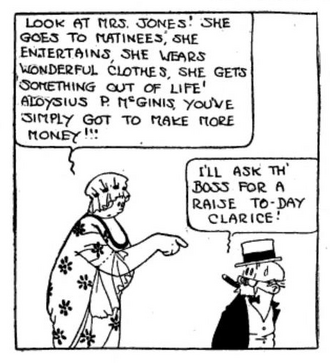
Conventional wisdom says you will go broke in this materialistic pursuit for socioeconomic status.
And you might.
But more likely you will go broke from something more pervasive and subconscious. Because, as Girard says, it’s not just about copying what your neighbors have, it’s about copying what they want, too, which is endless.
But it’s no longer just your neighbors. It’s your old high school friends on Instagram, the vlogging couples you see on YouTube, and the models you follow on TikTok. Also endless.
We haven’t yet evolved to deal with this level of visibility into the lives and experiences of billions of people around the world with no barrier to entry except a smartphone.
We are social animals who evolved in tribes of about 100 other individuals. In these small tribes, things like strength, resourcefulness, cooperation, and generosity were important and easy to see in action.
Status was often earned through the successful pursuit and practice of things like:
- Bring home a fresh deer to feed the tribe = status.
- Lead a strong display of strength against a quarrelsome enemy = status.
- Negotiate a favorable trade with a roaming band of merchants = status.
- Gift a pile of furs and tools to the family of a romantic pursuit = status.
- Tell captivating stories around the campfire at ceremonies =status.
- Memorize all the medicinal uses for herbs and flowers = status.
All of these activities provided status to an individual.
Unfortunately, almost none of these activities are easy to pursue in the modern day.
There are, of course, hunters, Marines, importers, playwrights, and doctors today, but even those roles are performed within narrow bands of expertise.
There are also accountants, gas station attendants, hair stylists, supply chain managers, social workers, and electricians… jobs that don’t lend themselves to earning traditional sources of status.
But the one surefire thing that still exists to communicate your status to others is material goods. Boats, houses, clothes, etc. etc.
That was fine when it truly was just your neighbors who saw all your stuff and vice versa.
Enter the first generation of social media.
Back in 2006, social media was just people you know. There was no For You Page or Explore tab.
It still allowed everyone else to perfectly tailor and share all the things that signal status with the flick of a thumb: friends at a party, expensive vacations, lavish weddings, new cars, fancy homes, attractive partners, and the list goes on.
At the same time, they needn’t share all the things you might have seen in the past such as arguments with a spouse, substance addictions, moments of anxiety, losing their temper with a child, a slovenly weekend, an overdue credit card bill, etc.
You know, all the things that made you not want to copy them.
That was hard enough to grapple with and we only had about 10 years before the algorithms entered the fray.
Algorithms serve up the things people pay attention to the most, so we are constantly bombarded with the things other people have and want, whether we know them personally or not.
So you have the perfect cocktail of highlight reels from people you know, endless imagery of amazing things from people you don’t, and it’s all a swipe away at the first moment of boredom or stress.
It looks something like this at the physiological level:
- Boredom or anxiety is the feeling.
- Your phone on the table is the cue.
- Dopamine spikes.
- The spiking causes you to open an app. (And if you don’t open the app, dopamine will literally drop below your baseline, causing you to want to open the app even more to get back to the baseline and then beyond it).
- Then the Explore page serves up things that are new, exciting, expensive, sexy, and cool.
- Mirror neurons fire, making you want to mimic what you see, whether or not you know the person posting it.
- But you can’t keep up with everyone, so it’s a never-ending cycle of wanting.
- Wanting but not attaining makes you feel bad, maybe just subconsciously.
- So you go into debt trying to show everyone all the things you’ve bought that you think they wanted and to show your status.
- Then you feel worse because you’re in debt and have buyer’s remorse and no one really cares about your stuff as much as you do.
- And you see your phone on the table.
- Dopamine spikes…
- Rinse and repeat.
The challenge today lies in breaking free from the algorithms meant to keep us engaged and feeling bad about ourselves. It’s hard to break free from because it doesn’t feel bad in the moment. Dopamine makes sure of that.
But it seeps in when you look up from your phone and subconsciously feel that your home or car or spouse isn’t as good as what someone else, anyone else, has.
The comparisons are no longer confined to looking out your window at your six closest neighbors. Now the comparisons come in the form of a small black rectangle in your pocket, at any time, at any place, in large concentrated quantities.
Keeping up with the Joneses was challenging enough. Keeping up with all of humankind, and trying to earn status in an ever more automated and isolated world is many times harder.
In my next post, I’ll share the ways I deal with this new reality. (Spoiler alert, I’m not great at any of this. But there are experts with advice that I listen to and try to put into action.)
For the time being, here are some related articles I’ve written on this topic:
- Why the Quality of Your Mind Influences the Amount in Your Bank Account
- Review: ‘The Social Dilemma’ (And Why You Should Watch It)
- Sensible Snack: The Number 1 Job of the Human Mind (And Why It Doesn’t Matter Much Anymore)
- How to Manage Lifestyle Creep (And Still Enjoy Your Money)
- Don’t Let Your Financial Life Become More Water Than Oil
- Millennials are Broken, Not Broke
- A Check Engine Light for Your Finances
To be notified of my monthly articles, subscribe below. No ads, no fees, no spam. Just mediocre financial content delivered straight to your inbox for a quick scan and then immediate deletion:





 Poor. Choices.
You must be logged in to post a comment.